August 23, 2026
Why context matters more than the headshot itself

A plain headshot tells a casting director or client who you are. A contextual portrait tells them what it’s like to work with you, which is a completely different job for a photograph to do. Say you’re a voice actor: a clean studio headshot proves you have a professional face. Put you at a microphone in a booth, headphones half on, and the image starts doing marketing for you before anyone reads your bio.
That’s the whole idea behind personal branding photography: identification versus demonstration. Before you book anything, decide which job the photo needs to do.
- Neutral headshot — best for casting databases, LinkedIn, agency rosters where consistency matters more than personality.
- Contextual portrait — best for a website hero, a press feature, or any place a viewer needs to understand your work in three seconds.
Most working creatives need both. Pick the primary use first, then plan the shoot around it.
Why context matters in artist photography for trust and results
Context does two jobs a plain headshot can’t. It builds instant trust, and it multiplies what one session is worth to you.
A casting director scrolling through hundreds of identical grey-backdrop headshots has no way to sense chemistry, energy, or fit. An environmental portrait that places you somewhere meaningful, a rehearsal space, a client meeting, your actual studio, closes that gap. The viewer isn’t guessing what you’re like to work with. They’re watching it happen. There’s a documented shift towards this style: headshot conventions generally are loosening up to include more environment and profession, because a name and a face used to be enough and now it isn’t.
Context also stretches your budget further, as professional photography beats tourist photos by delivering well-composed, well-lit images that serve multiple marketing and branding purposes. A single well-planned session can deliver images for your website, your socials, a press kit, and a casting profile, because each shot answers a slightly different question about you.
- Trust — location and setting reduce the guesswork a client or casting director has to do.
- Distinction — a contextual portrait doesn’t look like the next ten in a scroll.
- Return on investment — one session, planned properly, covers multiple platforms and uses.
The trap is overcorrecting into props for their own sake. A violin case in shot doesn’t mean anything if you’re a session vocalist, not a violinist, and a hard hat on a marketing consultant just reads as costume, not context. Every object on set should answer a real question about your work, not decorate the frame.
Pro Tip: If you can’t explain in one sentence why a prop or location is in the frame, cut it. “It looks professional” isn’t a reason. “This is where I actually direct rehearsals” is.
What levers actually change how a portrait reads
Five decisions shape whether a portrait reads as authentic or staged, and each one is worth thinking through before the camera comes out.
Location. Your real workspace gives the most authentic result but comes with mess, poor light, and limited backdrop variety. A rented space or curated interior lets you match a specific aesthetic that your actual workspace can’t deliver, which is why choosing locations beyond your immediate workspace is a common professional tactic. A neutral studio still wins when you need maximum flexibility across many uses, because it doesn’t compete visually with whatever background a client adds later.
Props. A prop earns its place only if it answers a question a client would actually ask. A director holding a script mid-note is context. A director holding an unrelated coffee cup as “atmosphere” is filler.
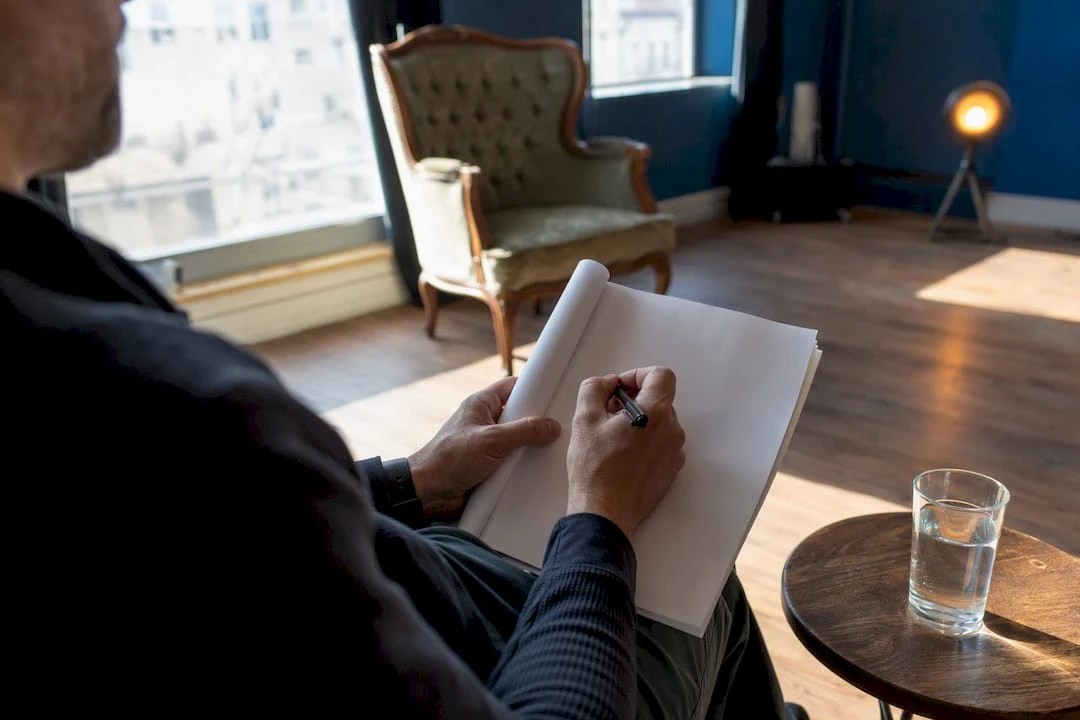
Wardrobe. Colour and texture do more communicating than most people expect. Muted, structured fabric signals authority; softer textures and warmer tones read as approachable. Avoid busy patterns near the face and keep contrast deliberate, not accidental.
Posing and movement. There’s a real difference between a “meeting” image, direct eye contact, still, composed, and a “working” image, mid gesture, looking slightly off camera, hands doing something. Meeting shots suit LinkedIn and casting profiles. Working shots suit websites and press features that need to show process.
Lighting and crop. Harder, higher-contrast light reads as more authoritative; softer, diffused light reads as more approachable. Crop matters just as much: a headshot cropped tight to the shoulders reads corporate, while a wider environmental crop reads editorial.
| Format | Typical use | Crop consideration |
|---|---|---|
| Square profile | Casting directories, social avatars | Face centred, minimal negative space |
| Website hero | Homepage, landing pages | Wide crop with a safe area for headline text |
| Banner/cover | LinkedIn, social headers | Extra horizontal space, subject off-centre |
| Portrait detail | Press, magazine features | Vertical crop, room for a caption or pull quote |
None of this works retroactively. Planning crops and formats before the shoot is standard advice in branding photography for a reason: a beautiful image with no room for a headline overlay is a wasted frame.
A shot list you can hand straight to a photographer
A good brief maps every image you need to an actual use, not a vague idea of “some nice photos.” Here’s the structure that works.
- List your image uses first. Website hero, LinkedIn banner, casting profile, three social posts, one press headshot. Count them.
- Define your audience and three brand words. If a casting director, a corporate client, and a festival programmer are all looking at the same gallery, your wardrobe and tone need to satisfy all three.
- Choose 2–3 locations and 3–4 props or wardrobe options to test on the day. Fewer, well-considered choices beat a dozen half-planned ones.
- Specify retouching level and deliverables. Natural skin retouching for a casting profile looks different from a polished corporate finish, and you should say which you want, along with file format and delivery deadline.
- Sort logistics in advance. Call time, hair and makeup, travel time to any on-location setting, and written permission if you’re shooting somewhere that isn’t yours.
An effective brief maps each required image to a concrete use, something like “website hero with safe area for headline,” “square profile for casting directories,” or “three social posts showing work in progress,” rather than a general request for “professional photos.” That level of specificity is what separates a gallery that gets used from one that sits in a folder.
How Emmet plans a context-led session at LemonSharkStudio
Emmet at Lemonsharkstudio starts most sessions with a conversation, not a camera. What roles are you playing this year? Who looks at your gallery, casting directors, clients, festival programmers? What images do you actually have gaps in right now? That conversation becomes the shot list, because photographers often treat the session itself as a discovery process that clarifies a client’s visual brand as much as it documents it.
A typical outcome looks something like this: an actor books a session expecting three headshots and leaves with a working gallery that includes a meeting-style headshot for casting, two environmental shots in a rehearsal setting, and a wider crop suited to a festival programme feature. Nothing wasted, nothing generic.
What clients consistently value from this approach:
- A gallery that actually matches the places it needs to appear, rather than a set of nice photos with no home.
- Faster turnaround on campaign or casting deadlines, because the shots were planned around use from the start.
- A stronger, more consistent personal brand across platforms, because every image was chosen with intent.
The psychological impact of context on viewer perception
Viewers make snap judgements from a photograph in a fraction of a second, and setting is one of the strongest signals feeding that judgement. A subject photographed against a plain grey backdrop gives the brain almost nothing to work with beyond facial expression. A subject photographed in a recognisable, meaningful space, a studio, a stage, a client-facing office, gives the brain a story to build around them.
This is why context reduces the guesswork a viewer has to do. Instead of inferring competence purely from a smile and posture, the viewer sees evidence: tools, environment, posture in relation to real objects. That evidence reads as more credible than a posed studio smile, because it looks less rehearsed even when it’s carefully planned.
There’s a flip side worth knowing. A mismatched context, expensive furniture behind a freelance illustrator who works from a spare room, can create suspicion rather than trust, because viewers notice inconsistency even when they can’t articulate what feels off. The setting has to match the story you’re actually telling, not the story you wish were true.
Framing and crop reinforce this further. A tight, direct crop with strong eye contact reads as confident and available. A wider environmental crop with the subject looking slightly away reads as focused, in process, less performative. Neither is better; they simply prime the viewer to expect different things from you, which is exactly why matching the crop to the use case matters as much as matching the setting to the story.

Common mistakes creatives make with context
The most common mistake is over-decorating rather than editing. A set dressed with five props “just in case” usually communicates less than one prop chosen with intent, because a cluttered frame gives the viewer too many competing signals to read quickly.
The second mistake is choosing a location that photographs well but has nothing to do with the work. A stylish café is a fine backdrop, but if you’re a software consultant, it tells the viewer nothing true about how you work. Context only helps when it’s accurate, not simply attractive.
A third pitfall is treating wardrobe as costume rather than signal. Dressing “as” a role, full theatrical styling for an actor’s headshot, for instance, often reads as staged rather than authentic, especially for casting use where directors want to see the real person, not a character performance in a still frame.
Fourth, many creatives skip crop planning entirely and end up with a gorgeous set of images that don’t fit anywhere they actually need to publish. A stunning wide shot with no safe area for a headline is unusable for a website hero, no matter how good the light was that day.
Finally, some sessions try to serve every possible use in one uniform style, producing a gallery that looks consistent but says nothing specific about any single use case. A shot built for casting and a shot built for a press feature rarely need to look identical, and forcing them to often weakens both.
How cultural context changes the way a portrait is read
Context doesn’t read the same way to every audience, and this matters more for creatives working across international markets, casting networks, or global clients. A formal, direct-gaze corporate portrait signals authority and trustworthiness in many Western professional contexts, but the same framing can read as overly rigid or even confrontational in cultures where softer eye contact and a more relaxed posture signal respect and approachability.
Setting carries similar weight. A minimalist, uncluttered studio background is often read as premium and modern in North American and Northern European markets. In other regions, a richer, more detailed environmental setting, showing tools, colleagues, or a bustling workspace, can communicate credibility and connection more effectively than a stripped-back studio ever could.
Wardrobe interpretation shifts too. Colours and formality levels that signal seniority in one market can read as either overly casual or oddly formal in another. An actor or creative marketing themselves to international casting directors or clients benefits from asking, plainly, what setting and styling will land well with this specific audience, rather than assuming one contextual approach translates everywhere.
None of this means abandoning a considered aesthetic. It means treating audience as part of the brief, the same way you’d treat platform or use case, so the context you choose actually lands the way you intend it to.
Book a strategy-led session with LemonSharkStudio
Ad hoc shoots waste money because nobody decided in advance what each image needs to do. A strategy-led session fixes that before the camera comes out, mapping every shot to a real use so you leave with a gallery that works across casting, web, and social instead of a folder of nice but homeless photos.
Lemonsharkstudio runs sessions this way as standard, in studio or on location around Fulham and West London, with a discovery conversation upfront that becomes your shot list. If you’re ready to book, head to the studio booking page or, if headshots specifically are what you need, the dedicated headshots landing page has package details and deliverables. When you enquire, include your primary image uses, your audience, and two or three location or wardrobe ideas, and take a look through the gallery of previous sessions while you’re there for a sense of what a context-led shoot actually produces.
Why context is a career asset, not a one-off purchase
The mistake most creatives make is treating a photography session as a box to tick once and forget. Your work changes, your audience changes, the roles you’re chasing change, and a gallery shot three years ago quietly stops telling the truth about who you are now.
A working rule worth adopting: refresh contextual imagery roughly every twelve to eighteen months, or sooner if your primary work setting, audience, or professional focus shifts noticeably. Treat it the same way you’d treat updating a CV or a portfolio. It’s routine maintenance, not a luxury purchase.
The creatives who get the most out of this understand that context photography is infrastructure for how people find and trust them, not decoration for a website that already works fine without it.
Sources
- Personal branding photography vs headshots: what’s the difference (really)? — Katie Kaars Photography
- Environmental personal branding photos — John Ferguson Photography
- Personal brand photography — Jordan Brittley
- Context is the new backdrop — Carol Wehling
FAQ
What’s the difference between a headshot and a contextual portrait?
A headshot identifies you, usually for a directory, casting database, or profile. A contextual portrait places you in a meaningful setting to show how you actually work, which is a stronger tool for websites, press, and personal branding.
How many locations should I plan for a branding session?
Two to three locations is usually enough to give variety without overloading the day; more than that tends to eat time better spent getting strong images from fewer settings.
Do I need props for a personal branding shoot?
Only if the prop answers a genuine question about your work. A prop chosen purely to look “professional” usually reads as staged rather than authentic.
How often should I refresh my professional images?
Every twelve to eighteen months is a sensible baseline, or sooner if your work setting, audience, or professional focus changes noticeably.
Can Lemonsharkstudio help me plan the shot list, not just take the photos?
Yes. Lemonsharkstudio’s sessions start with a discovery conversation that maps your image uses into a shot list before the camera comes out, which is the same planning approach covered throughout this guide.
Recommended
Need photos of your own?
Headshots, team portraits and personal branding, shot in Fulham or on location across London.